In the late 1980s the Rotary Club of Camberwell ( RCC) was talking about the fact that so much good quality food was being dumped into landfill just because it was out of code and it was illegal for it to be sold in food shops, at a time when so many less fortunate people were going hungry.
Cromwell Beggs, a long-term member, had looked at what was being done in the USA, to harvest such food and redistribute it to the needy, and he challenged our members to “do something “ about this critical issue, in our capacity as a well-known socially active community service club.
During the early 1980s Harry Heaths, a local supermarket recognized that his business, alone, was dumping many hundreds of tons of good food, at great cost to his business, By mid 1980s, Geoff Heath, Harry’s son, had taken over management of the supermarkets and he knew that something had to be done and his additional research from USA led him to believe that our Club could DO something.
He had a chat to Michael Mullins and Alan Carra said that if we could get an umbrella Organisation which could provide legal insurances and business support services, we could solicit good food from food suppliers and redistribute the food to local support groups in the suburbs, who in turn, could hand out the food to those most in need. That obviated the need for us to have to determine who was most in need. We chose the Council for Homeless Persons, a government sponsored organization, to be our umbrella, as they had previously done some research in the need for a foodbank but did not know how to implement the concept.
We needed premises that would enable us to collect and store the food, and it had to have refrigeration facilities. The location needed to be close to our food sources and in the vicinity of our client charitable organizations such as the Salvos, local church groups etc.
CHP sourced a worn out, vacated food preparation building which was still owned by Spotless Catering. The wonderful CEO of Spotless said they could not accept anything more than a dollar rental per annum, and all we had to do now, was to find a refrigeration truck and we would be off and running. The premises were in Airport West, where there were large communities of needy people.
The Rotary Club of Balwyn had the finances from the ever-popular Camberwell Sunday Market and they offered to purchase a refrigeration truck so all we had to then do was to get a driver. We needed volunteers to assist to collect, collate, sort and distribute the food to the car boots of the charities.
We also needed a manager and a few experienced workers who understood the process of collection and distributing food in a way that was fair and practicable to all. We arranged for Kangan Institute, a local training organization, to supply students to act as volunteers who were, in the process of learning food handling techniques, as part of their courses.
Now we had the structure, we needed. Local supermarkets were more than happy to give us suitable food, so long as we undertook not to resell the food which would have competed with their businesses and would have been illegal anyway.
Soon we had Heinz Kraft and Nestle on board sending us food production overruns and SPC in Goulburn Valley did the same. In fact, the wonderful people at SPC (management, employees, growers and suppliers) donated their time and resources once a year on a Saturday where they ran their machines with all production for the day going to Foodbank.
Don Jago, a prominent member of our club, had a contact in the Riverina rice growing industry and he negotiated for us to buy bulk rice at bases rates, which was perfect for our client base as we could bag up the rice in bags big enough to be made into a meal for a family. Rice is such a practical food product to give a family.
A similar project was developed where we had 10 or 20 tons of wheat donated and were able to get processed into pasta which is another important basic food item across many different cultures.
Great news that Vic Rail transported the produce to their Melbourne depot free of charge.
We made the decision that we should not supply cooked foods but supply the base food stuffs to the recipients so they could make best use of the food in the manner they were accustomed to.
Initially we were supplying food to several local groups but within a year it had grown to a few hundred local charities, but the need was greater as the word got round rapidly.
Foodbanks were later set up in Latrobe Valley, Bendigo and Dandenong.
We worked with foodbanks setup in Sydney, Brisbane and Perth to share donated stock from multinational companies that we split based on population.
We seemed to be going well, and a lot of needy people were being fed, but we were desperately short of cash to expand the increasing need for assistance in Victoria.
The government, naturally, said there were no needy people in Victoria, so we were pretty much on our own. But there was a community awareness of the good work being done and the Governor of Victoria came out to inspect the project and the publicity was invaluable.
The chair of ANZ Charles Goode heard of our good work, and he determined that we should not fail so he requested the CEO of the Potter Foundation, John Kellaway, to get involved and assist us. This was a blessing for foodbank as John came onto the management committee and he brought enormous management skills to our project. In addition, Ken Hayes, a former director of the Leader Newspapers and a member of our Club, came on board and Helen McLean, a very skilled manager and wife of our member Tom McLean, bought extra skills and innovations to our management team.
With the installation of thousands of poker machine licenses being sold off by the government, to clubs and hotels, the demand for food increased massively from approximately 15000 people per week to close to 30000 per week.
We were now a serious and valuable asset to Victoria, and Geoff had been working to coordinate all the other State foodbanks so we could all speak and manage our food collection, distribution, purchasing power and political clout to best use. This led to the creation of Foodbank Australia.
Victoria had been working, under a statute for many years, the charitable organization of Vic Relief headed by Dame Phyllis Frost. Vic Relief was set up after the depression mainly focusing on disaster relief, but the government realized that a rationalized umbrella organization of disaster and food distribution would be more effective, so Foodbank and Vic Relief were merged with the foodbank management rationalizing the whole process. The Victorian Government funding the capital costs of the project.
The joint organization was rebranded to Foodbank Victoria and, as at mid December 2025 our little baby is feeding 69,000 people a day.
As with all successful Rotary projects, our club moved out of the management when the project was able to stand on its own feet.
The Rotary Club of Camberwell:
- Recognized a need
- Assessed that need
- Facilitated the need
- Succeeded
- Got out, with much pride.
Michael Mullins and Geoff Heath



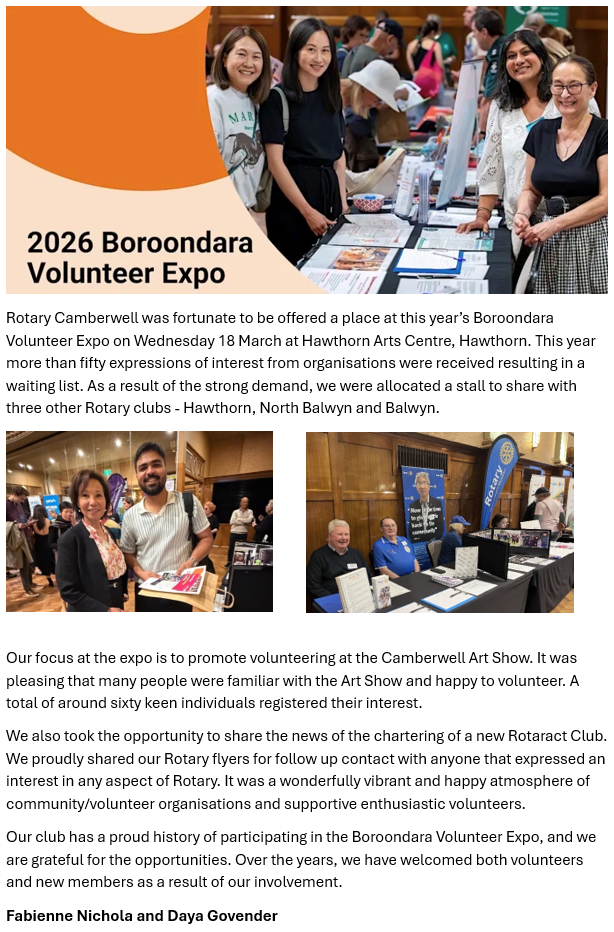

 Your help is needed! Volunteers are required for the following event. Click on